From the Battle of Midway to the Navy’s underwater sound laboratory
By Dave Bowman, USSVI National Historian
The Colors Come Down
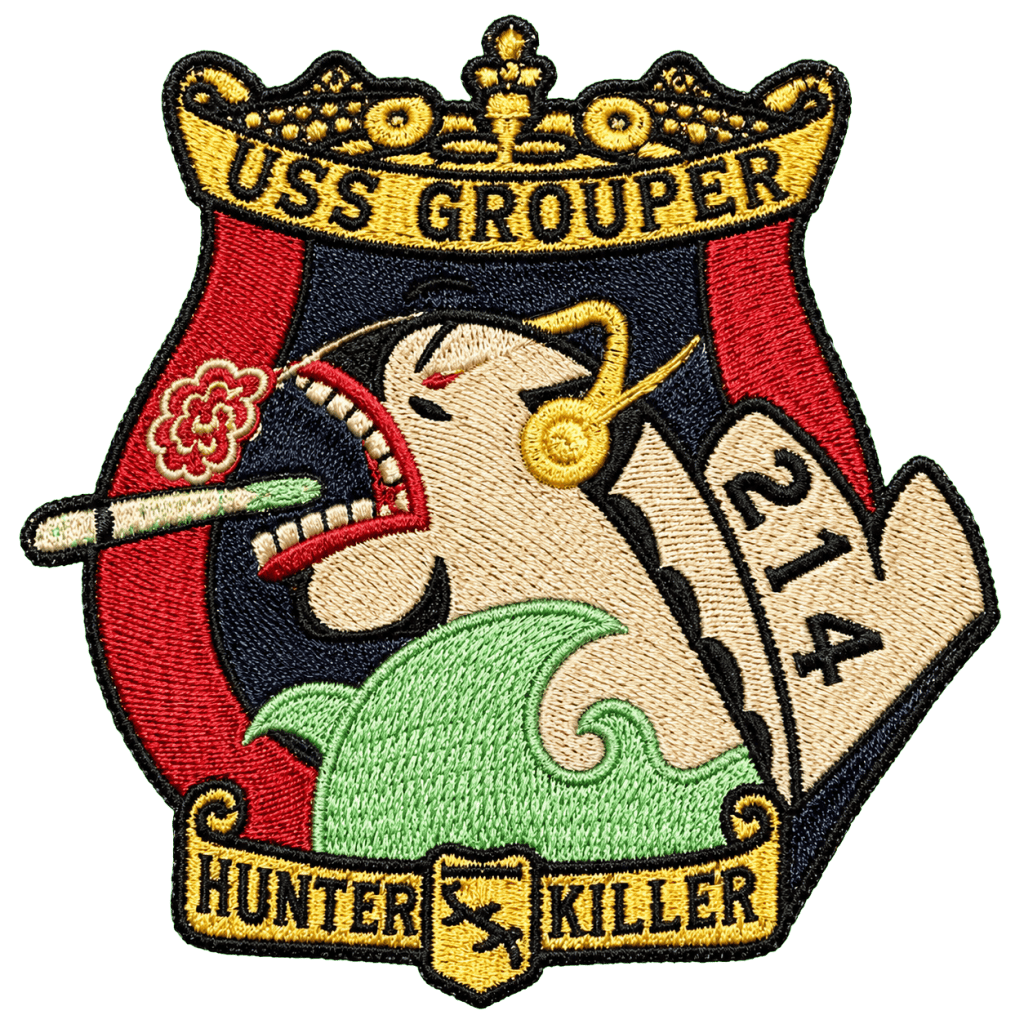
On Monday, December 2, 1968, the Navy lowered the colors aboard USS Grouper at the submarine base in Groton, Connecticut. The previous day, the Hartford Courant had laid out the plans for Pier 11. Rear Admiral Nace, commanding Submarine Flotilla Two, was to speak, and Commander William Dowe Jr. was to read the orders turning the boat over to the base for disposal. The newspaper recorded the crew’s answer to anyone who thought age explained the attention. “We’re not the best because we’re the oldest, but the oldest because we’re the best.” [1]
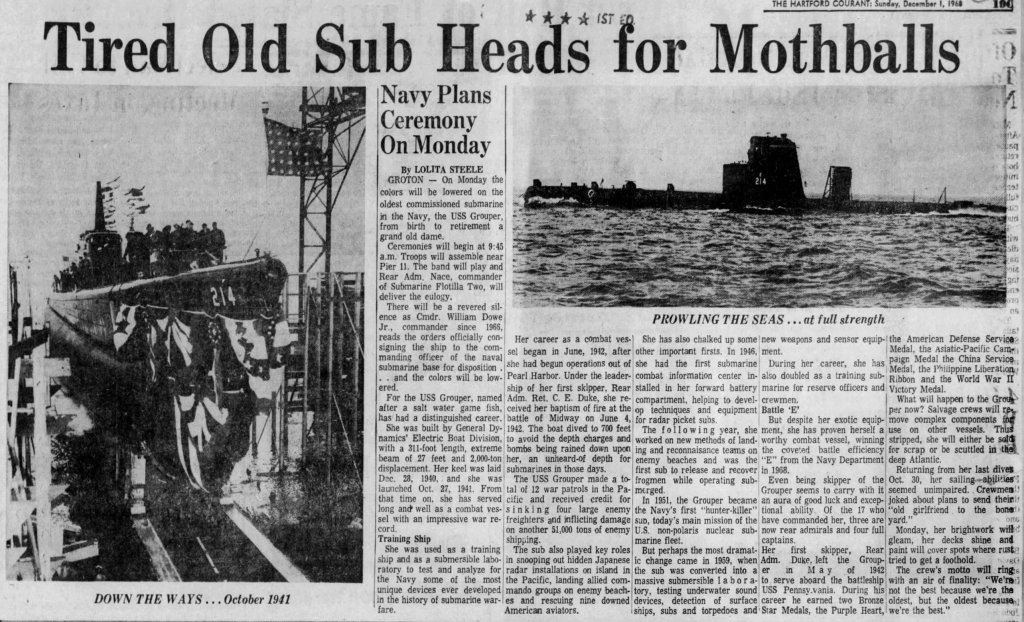
Grouper had been in commission for nearly twenty-seven years. She had passed the longevity mark associated with USS O-4 in 1965 and retired as the Navy’s oldest commissioned submarine. She had earned ten battle stars in the Pacific, but the equipment on her deck at Groton belonged to another era. A tall sonar array stood aft of the sail. The forward torpedo room where sailors once handled weapons now held instruments, workbenches, and bunks for scientists. Those changes help explain how a hull laid down before Pearl Harbor stayed useful well into the nuclear age. [1, 2, 9]
A Fleet Boat Goes to War
Electric Boat laid down Grouper in Groton on December 28, 1940, and launched her on October 27, 1941. Mrs. Albert F. Church sponsored her. By the time the boat commissioned at New London on February 12, 1942, under Lieutenant Commander C. E. Duke, the United States had been at war for two months. Following shakedown in Long Island Sound and torpedo trials at Newport, Grouper sailed on March 30, passed through the Panama Canal, and reached Pearl Harbor on April 26. [2, 3]
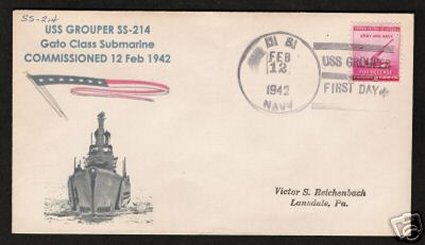
At 311 feet 9 inches, Grouper was a Gato-class fleet submarine with six 21-inch torpedo tubes forward and four aft. She could carry twenty-four torpedoes. Her diesels drove generators, and electric motors turned the screws. On the surface she could make about twenty-one knots and cover the distances a Pacific patrol demanded. Submerged, she relied on batteries, and sustained speed came at a steep cost in endurance. The class had a 300-foot test depth. A later generation would call these boats “thin skins,” a description that carried particular weight for Grouper’s first crew. [2, 3]
Before her first numbered war patrol, Grouper joined the submarine screen at Midway. On June 4 she sighted two burning Japanese carriers, but aircraft kept her from closing. Fighters strafed her and aircraft and destroyers forced her down. The Navy’s ship history puts the day’s total at more than 170 bombs and depth charges. The retirement account in the Courant says the submarine reached 700 feet. That extraordinary figure comes from the later newspaper account and should be read as a reported depth. On June 5, Grouper dived again to avoid bombers. She then took on fuel and provisions at Midway before sailing west on June 12. [1–3]
The First Two Patrols and Lisbon Maru
The first patrol took Duke into the western Pacific, toward the shipping routes linking Japan with Formosa and the China coast. On June 25, east of the Bonin Islands, Grouper torpedoed and damaged the large Japanese oiler Tonan Maru No. 3. The Navy credited the patrol with damage to two merchant vessels. Neither became a confirmed sinking. Grouper returned to Pearl Harbor on July 30 and Lieutenant Commander Rob Roy McGregor took command. [2–4]
McGregor sailed on August 28 for the East China Sea. On September 21, east of Shanghai, Grouper sank the 4,070-gross-ton freighter Tone Maru, her first confirmed sinking. Ten days later, near the Zhoushan islands off China, lookouts picked up another loaded Japanese ship. She was the 7,053-gross-ton Lisbon Maru, bound from Hong Kong to Japan with freight and 778 Japanese troops. The Americans could see an enemy vessel. Nothing on her hull or in her flags warned them that some 1,800 Allied prisoners were below decks. [3–6]
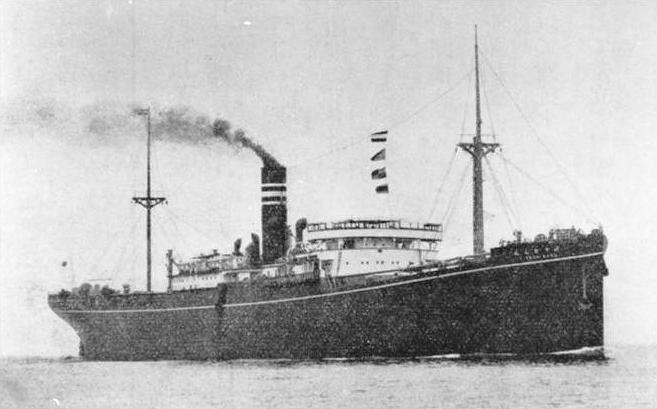
McGregor followed the ship into daylight and attacked submerged on October 1. The opening shots missed. A subsequent torpedo disabled the transport, although McGregor initially saw little outward damage. The ship fired at the periscope. He made further firing runs, and a Japanese aircraft dropped depth charges after his final shot. When the freighter vanished from the periscope view, McGregor inferred that she had sunk. In fact, she stayed afloat into the following morning. Grouper left without knowing who was in the holds. [5, 6]
The prisoners had been captured at Hong Kong. They included men of the Royal Scots, the Middlesex Regiment, the Royal Artillery, and the Royal Navy. As Japanese vessels evacuated the troops, the guards kept the prisoners below and the hatches were battened down. Water entered the ship. Men struggled to pump it out, and prisoners in the darkened holds waited through the night with little air. On October 2, as the stern settled, prisoners cut their way out. Japanese guards fired on escaping men, and many more drowned or went down trapped in the holds. [6]
Chinese fishermen from the neighboring islands took small boats out and rescued 384 men by one frequently cited count, sheltering survivors in homes and temples. Japanese forces recaptured most of those brought ashore, but islanders hid three men and helped them reach Allied lines. The trial record puts 1,816 prisoners aboard. The commonly cited roll of honour records 828 dead, and other accounts give somewhat different figures. Surviving prisoners were taken to Shanghai and then sent on to Japan, where more men died in captivity. [6]
The patrol report and the postwar trial record establish different parts of the same event. McGregor attacked an armed Japanese military transport whose prisoners were invisible to him. Japanese authorities knew the prisoners were aboard and kept them confined after the ship had been hit. A British military court in Hong Kong convicted the ship’s master, Kyoda Shigeru, for his role in their treatment. The distinction matters when reading a sinking credit. The torpedo explains why the ship went down. The decisions made aboard her after the hit explain why so many men had so little chance to get off. [5, 6]
Coastwatchers and Radar Stations
Grouper left Pearl Harbor on November 12, 1942, for her third patrol, working southwest toward the Solomons. On December 17 she sank the passenger-cargo ship Bandoeng Maru northwest of Buka, at the northern end of the Bougainville chain. The ship was carrying reinforcements toward the Solomons. Grouper ended the patrol at Brisbane on December 31, where the American boats operating from eastern Australia were within reach of Japanese supply routes through the Bismarcks and the Solomons. The patrol drew a favorable endorsement from Admiral William F. Halsey’s South Pacific command. [2, 3, 7]
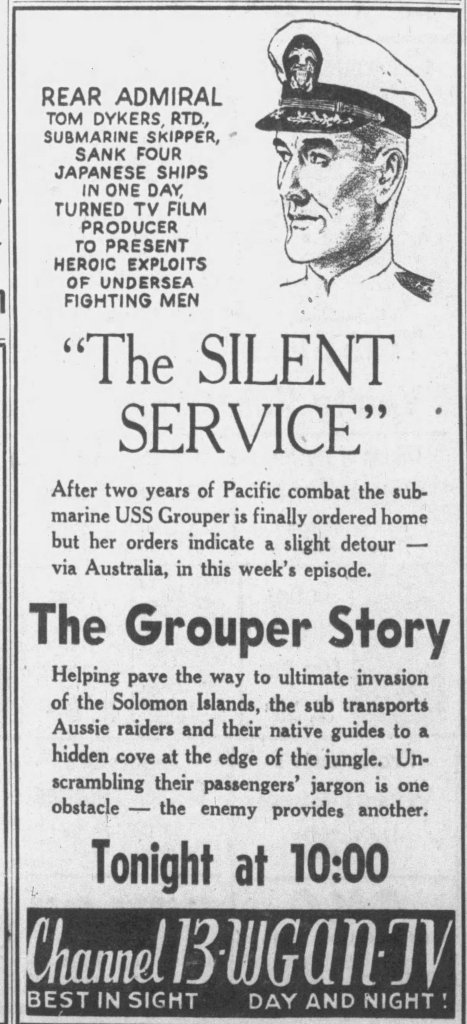
Before McGregor left Brisbane on January 21, 1943, for his fourth patrol, technicians fitted a Philco ARC-1 radar-intercept receiver. It could use the SD air-search radar antenna for listening. The distinction was important. A radar transmits and listens for its own echoes. An intercept receiver listens for someone else’s transmissions. By taking repeated observations offshore, the submarine could help locate transmitters and distinguish a rotating search set from one that appeared fixed. Taking such a receiver into enemy waters made Grouper a pioneer among the American boats operating from Australia. USS Drum had already received an ARC-1 at Pearl Harbor in 1942. [7]
The fourth-patrol endorsement listed contacts at Rabaul on New Britain and at Wewak, Aitape, Bogia, and Madang along the north coast of New Guinea. It also listed Buka, Gatukai, and Faisi in the Solomons. Cape Cretin remained doubtful, and the crew recorded what appeared to be a shipborne radar north of Kavieng. Those observations gave Allied radar-countermeasures specialists evidence about where Japanese operators could detect approaching ships and aircraft. They became part of a wider collection effort later coordinated by the Southwest Pacific Area’s Section 22. Halsey commended the patrol’s radar work. [7]
The boat still hunted ships. On February 4, McGregor worked between the columns of a Japanese convoy and was preparing to fire at a destroyer when Allied aircraft attacked the convoy. The destroyer changed course, Japanese fighters appeared, and Grouper went deep. On February 10 the submarine picked up Army First Lieutenant Lawrence R. McKulla, who had reached Rengi Island after bailing out of his P-39. Grouper returned to Brisbane on March 18 without a sinking. The rescued pilot and the radar report were concrete results of a patrol on which the gun and torpedo tally told very little. [2, 7, 8]
Lieutenant Commander Martin P. Hottel took Grouper out on her fifth patrol on April 12 and brought her back on May 29. There were no confirmed sinkings. His sixth patrol, beginning June 19, took the boat south of Truk, where she made submerged torpedo attacks and had to break away from escorts before she could establish the results. A running torpedo could pass below a target, detonate prematurely, or fail on impact. Those were distinct faults in the Mark 14 and its Mark 6 exploder, and early patrol observations did not always establish which fault had occurred. A loud explosion, particularly before the expected time of impact, was poor evidence of a hit. A circular run was a separate hazard, a steering failure that could bring a weapon back toward its own submarine. [4, 8, 11]
On July 30, while Grouper was returning toward Brisbane, a U.S. Army Air Forces B-25 Mitchell mistook her for an enemy submarine in the Coral Sea east of Rossel Island. Hottel crash-dived. Two depth charges exploded while the boat was still shallow, and she reached Brisbane on August 3 to go alongside the submarine tender USS Fulton for repairs. The episode showed the limits of recognition procedures under the conditions in which patrol aircraft actually worked. A bomber coming out of rain squalls and a submarine hurrying below the surface had little time to identify each other. [8, 11]
On the seventh patrol, which began August 25, Grouper carried an Australian-led party and supplies for operations on Japanese-held New Britain. On September 28 the men and cargo went ashore by rubber boat to support coastwatcher Malcolm Wright. The Navy’s account gives fifty men and 3,000 pounds of gear. A detailed reconstruction distinguishes the fifty embarked from forty-three put ashore. Coming the other way was Captain Arthur L. Post, an American photo-reconnaissance pilot who had evaded capture for nearly three months after abandoning his F-5 Lightning. Hottel resumed patrolling and attacked shipping on the Rabaul–Truk route before ending the patrol at Pearl Harbor on October 11. [2, 4, 8]
Grouper reached San Francisco for overhaul on October 19, 1943. Lieutenant Commander Frederick H. Wahlig took command in November and brought her back to Pearl Harbor in January 1944. During training there, accidental flooding damaged the conning tower, control room, and pump room. Repairs delayed her return to operations. The eighth patrol finally began on March 1. Rough seas complicated the outbound passage, and the boat stopped at Midway before proceeding west. She ended the patrol alongside USS Sperry at Majuro on April 28 with no confirmed sinkings. The 1943 yard period thus fell between the seventh and eighth patrols, despite the sequence printed in the Navy’s traditional ship history. [2–4, 8]
Japanese Home Waters and Lifeguard Duty
Wahlig sailed from Majuro on May 22, 1944, for the ninth patrol. On the night of June 24, south of Yokosuka, he made a surface attack that sank the 2,857-gross-ton cargo vessel Kumanosan Maru, also rendered Kumanoyama Maru. The patrol ended July 6. The postwar Joint Army-Navy Assessment Committee credited Grouper with four ships totaling 17,983 gross tons. The larger figures that appeared in retirement coverage reflect different wartime assessments or combine damage estimates with sunk tonnage. [1, 3, 4, 8]
The tenth patrol, August 14 to October 15, took Grouper into the operations supporting American air strikes in the western Pacific. Off the Palaus in September she rescued seven downed naval aviators. On lifeguard station a submarine had to remain near the area where aircraft might come down, then expose herself long enough to recover their crews. It was work that required a boat to be in the right patch of sea when a pilot had little time left. Grouper also joined the coordinated attack group known as Bear, with USS Seahorse, USS Whale, and USS Segundo, on September 14. Orders detached her from the group on September 28. [2–4]
The eleventh patrol ran from November 9, 1944, to January 1, 1945. On November 11 USS Icefish sighted Grouper in the central Pacific and the two exchanged identification signals. The twelfth patrol began on March 3. By April 15, off Saipan, Grouper was at sea with USS Kingfish helping escort the infantry landing craft LCI(L)-371. Neither patrol added a confirmed sinking. The boats were operating in a Pacific where Japanese merchant traffic had already suffered severe losses and submarine assignments increasingly included rescue and fleet support. [2–4, 12]
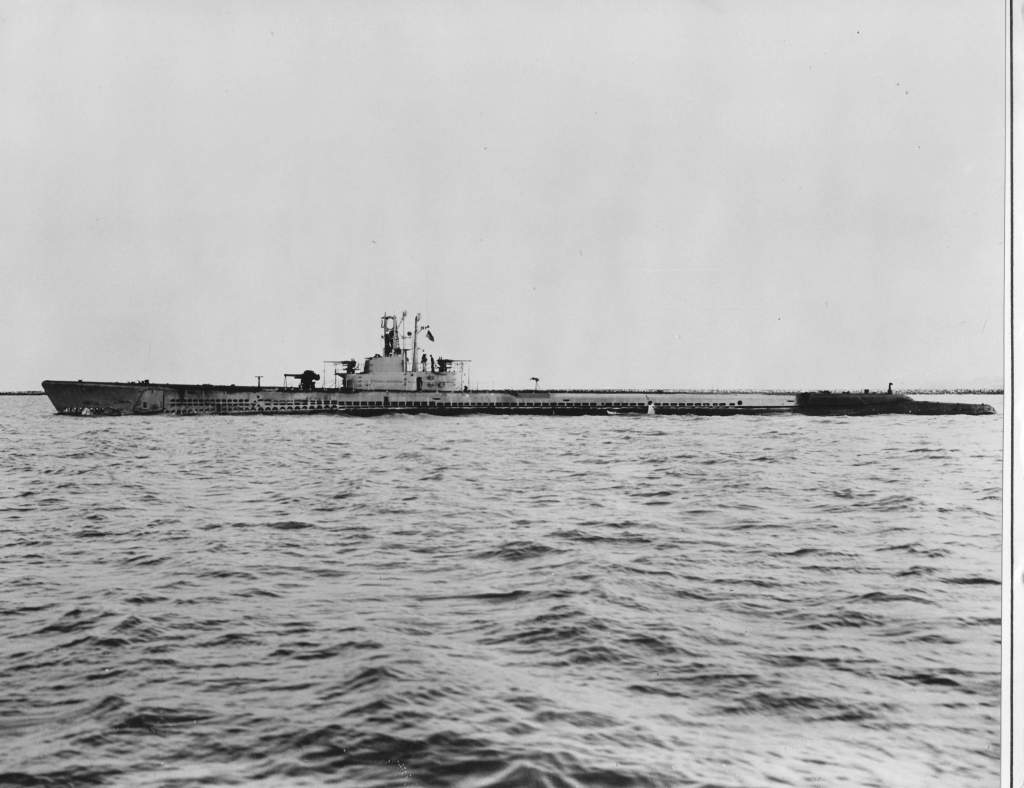
Grouper ended her twelfth patrol at Pearl Harbor on April 26 and sailed for a West Coast overhaul the following day. Commander Maurice H. Rindskopf took command in May. A July 17 photograph off Mare Island shows the veteran with a new gun fit and disruptive camouflage, still being prepared for combat. She reached Pearl Harbor on August 6, but Japan’s surrender canceled another patrol. On September 9 she sailed for New London in company with USS Toro and USS Blackfish. [2, 3]
The Hunter Killer Prototype
The return to New London opened several years of training and exercises from the northeastern United States to Florida and the Caribbean. In 1946 Grouper became the first U.S. submarine to receive a combat information center, installed in the forward battery compartment. A CIC gave the boat a place to assemble and plot information from different sources, a capability the Navy needed as submarines took on radar-picket work. In 1947 Grouper pioneered the discharge and recovery of swimmers from a submerged submarine underway. Her wartime landing party had gone ashore in rubber boats. The postwar trials explored how to put men in the water and bring them back while the submarine stayed below. [1, 2]
The Soviet submarine buildup gave the Navy another reason to keep the old fleet boat. Germany’s Type XXI had pointed toward a submarine designed to spend more time submerged, and the Soviet Whiskey-class program would put large numbers of new diesel-electric boats into service. The Navy needed to find such submarines before they reached shipping lanes or fleet operating areas. A submarine with sensitive passive sonar could listen from below the surface without giving away its presence by transmitting. [9, 13]
Grouper entered Mare Island Naval Shipyard on March 5, 1950, for the prototype hunter-killer conversion associated with Ship Characteristics Board project 58. Her deck guns came off, the fairwater was reshaped, and a snorkel allowed her to run diesels at periscope depth. Her large BQR-4 passive sonar array wrapped around the forward part of the bridge fairwater. The fitting was distinctive. Several later fleet-boat conversions carried their large array at the bow. Grouper was redesignated SSK-214 on January 2, 1951, and emerged from the yard on June 27. [2, 3, 13]
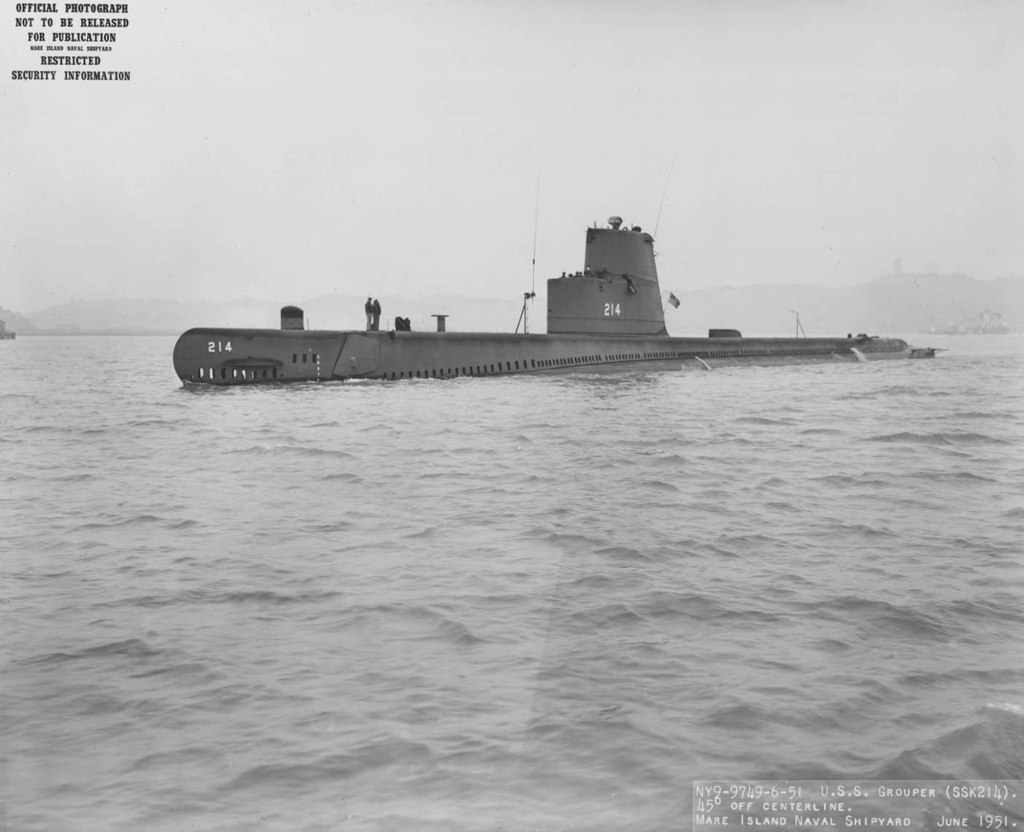
With Submarine Development Group Two, Grouper helped work out how a submarine could search for, track, and approach another submarine. The exercise areas ranged from Nova Scotia to Florida and the Caribbean. In 1953 and 1955 she crossed the Atlantic via Iceland to Rothesay, Scotland, and in the fall of 1957 she participated in NATO maneuvers. These years gave the Navy experience using sonar and working against other submarines under conditions that changed with the water, the weather, and the ships taking part. The installations also exposed limitations that could only be found at sea. [2, 9, 13]
The Underwater Sound Laboratory
By the late 1950s, scientists were repeatedly installing and removing equipment aboard Grouper between other assignments. That arrangement made it hard to maintain a sustained research program. The Navy redesignated her AGSS-214 in 1958, with May 17 the date given in the Navy’s ship history, and sent her to Portsmouth Naval Shipyard in November 1959. When she left the yard on June 23, 1960, she was a dedicated research submarine for the Naval Research Laboratory and the Navy Underwater Sound Laboratory. [2, 9]
The yard removed the forward torpedo tubes and turned the space into a laboratory with an acoustically insulated sonar console room, recording equipment, and accommodations for six scientists. Operators could select among different hydrophones and projectors and preserve both raw and processed signals for later analysis. The boat received a motor-generator set in the former No. 7 main ballast tank to meet the new equipment’s electrical demands. Changes to fittings below the hull made it easier to rest the boat on the bottom for experiments. [9]
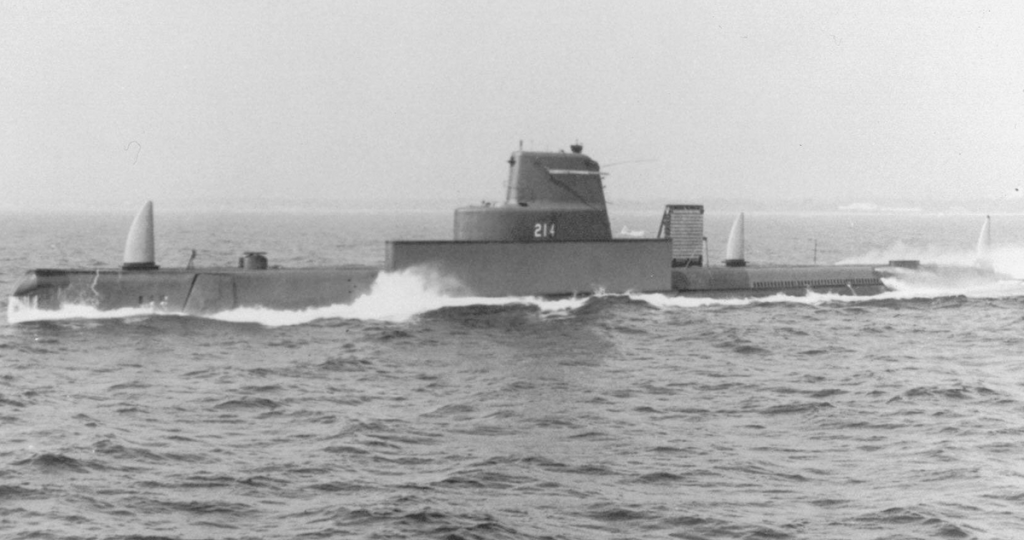
The most conspicuous addition was Colossus, a flat active sonar array mounted aft of the sail. The deck also carried three fin-shaped arrays associated with the passive PUFFS system, a trainable sound projector at the bow, and a line of baffled hydrophones along the fairwater. PUFFS used separated listening stations to help estimate range without sending out a ping. Colossus could put sound into the water for controlled measurements. An account preserved with the boat’s photographs recalls a tendency to roll to port on surfacing and describes the deck array as a stability concern. At sea the crew had to live with equipment built to answer scientific questions. The combination gave the laboratories a way to vary an experiment without rebuilding the boat for each trial. [3, 9]
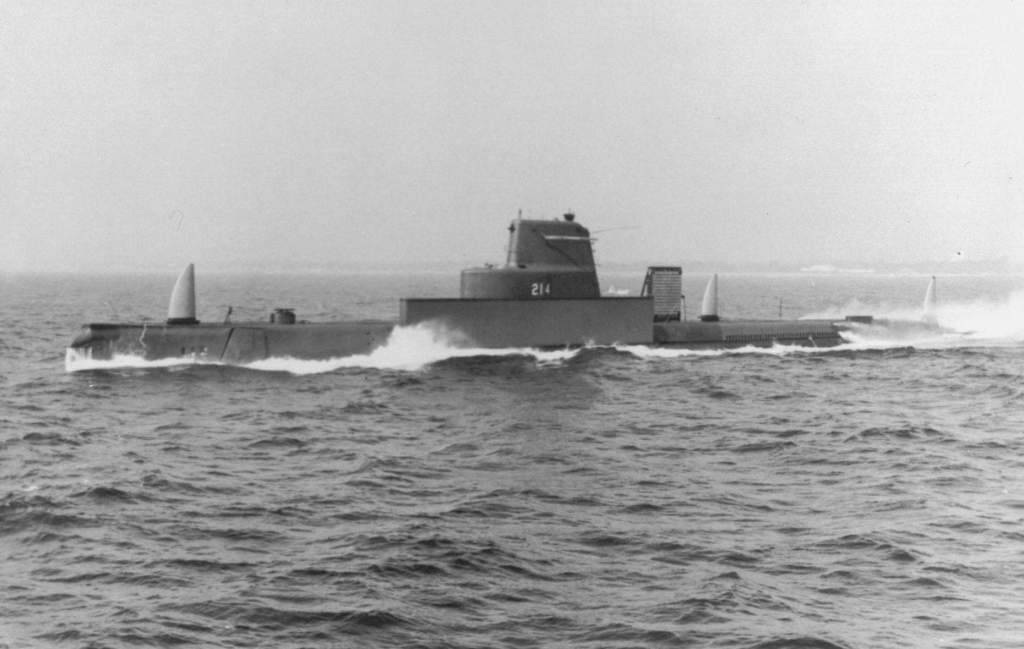
PUFFS passive ranging hydrophones (ten-footers) are in the three large fins. The billboard-like housing for the “planar array” made for stability concerns – Grouper always rolled to port on surfacing. During surface transits strict rig-for-dive was broken to run with the LP blower lined up to blow port side only, because of the list she sometimes developed in weather. Aft of the sail is the Colossus active sonar. It was powered by a large MG set in (converted) #7 MBT. Not visible: Linear array of line hydrophones which ran the length of the starboard side. Prairie and Masker air piping (extra large blower in pump room). All six forward torpedo tubes removed. (NAVSOURCE)
The central question was what happened to an acoustic signal after it left its source. Changes in temperature and pressure bend sound paths. A signal can be trapped in a layer near the surface, travel by way of reflections from the seabed, or propagate over long distances in the deep sound channel, commonly called SOFAR. The receiver may hear different arrivals from the same transmission, or hear remarkably little because it lies in a shadow zone. Work in the waters off Bermuda and in the Caribbean let researchers compare what instruments recorded at sea with what their models predicted. For the fleet, the results could inform where to place an array, how to isolate it from machinery noise, and what performance to expect from a sonar in different waters. [2, 9]
The laboratory years involved repeated yard work. A Philadelphia overhaul beginning in December 1962 kept her there until May 1963. She earned a Battle Efficiency “E” in June 1964 and returned to Philadelphia for further modifications in November 1965. Back in service in 1966, she conducted Caribbean research and worked in Narragansett Bay and off Bermuda. New London remained her home port, and her assignments took her as far north as Nova Scotia. The Navy was bringing nuclear boats such as Tullibee and Thresher into service and developing the following generations of attack submarines. Grouper supplied a place to evaluate equipment and check the assumptions behind new sonars without taking front-line boats away from their other duties. [2, 9, 13]
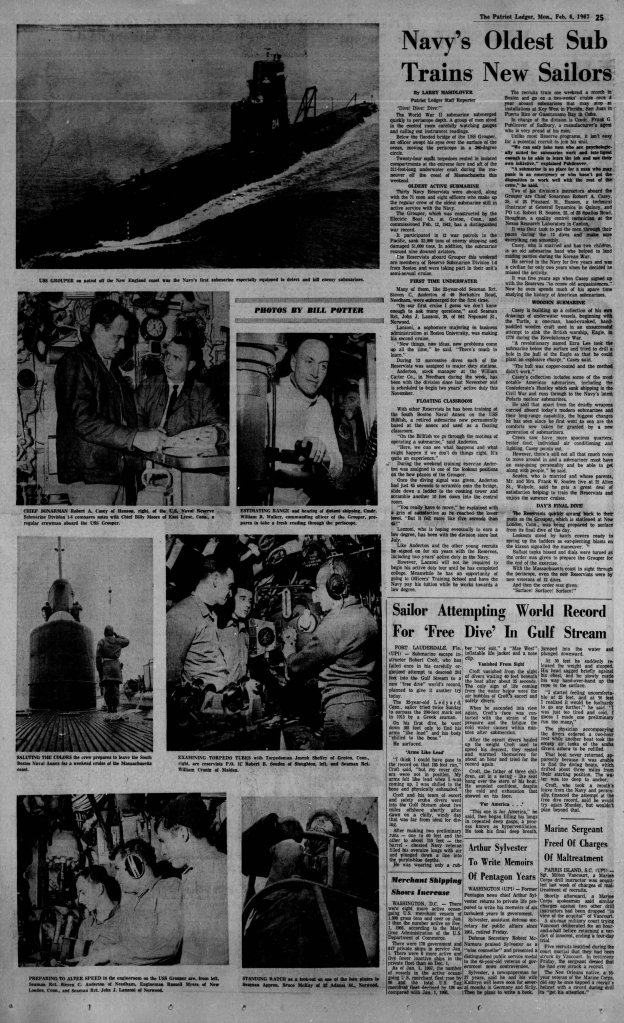
She also remained a working training boat. In February 1967, the Patriot Ledger went to sea with thirty reservists from Submarine Division 1-8 out of Boston. For some, it was their first time underwater. They rotated through stations over twelve dives, working beside regular crewmen. Seaman Recruit Steven Anderton went from lookout duty on the bow planes through the bridge and down into the control room when the diving alarm sounded. The group had practiced aboard the retired USS Billfish at the South Boston Naval Annex. Aboard Grouper, the students had to keep pace with a boat that was actually diving. [10]
The Last Dive
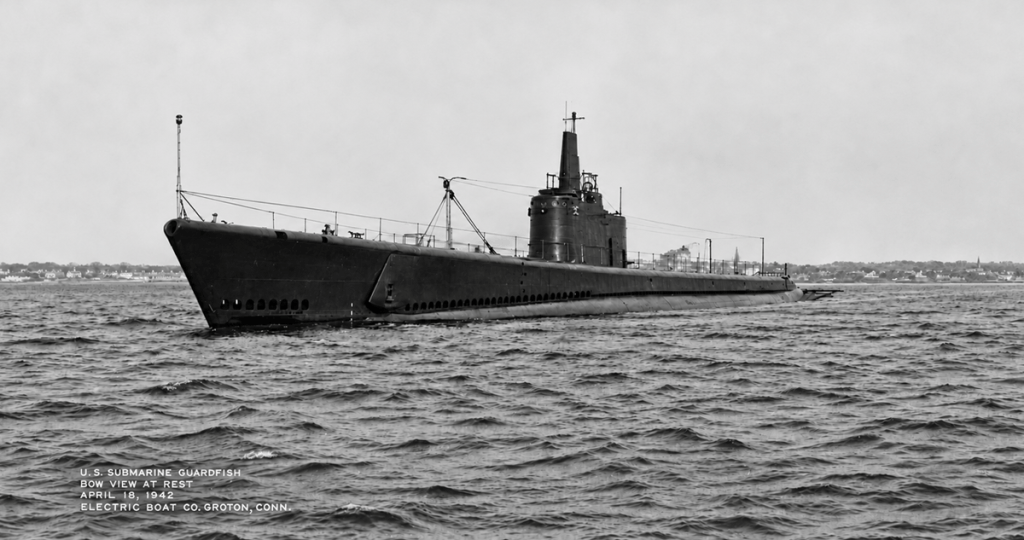
The Courant reported that Grouper made her final dives on October 30, 1968, and recorded another Battle Efficiency award that year. The boat was decommissioned and struck from the Naval Vessel Register on December 2. Ship registers and the photographic record place her sale for scrap on August 11, 1970. The launch and laboratory photographs show how much the Navy had changed around hull 214. Between them lay twelve patrols, a Pacific war, and two decades spent testing how submarines would operate in the next one. [1, 3]
The most revealing part of the record is how often a job worth doing could disappear from the customary tally. A report that ended without a sinking might describe a pilot brought out of occupied territory, an enemy radar located off New Guinea, or men and ammunition delivered to a coastwatcher’s party. The work continued after the war in a different form, when a trace on an instrument could tell a scientist why a sonar heard a target one day and missed it the next. At Groton the Navy lowered the colors on a boat whose crews had spent nearly twenty-seven years finding out what a submarine could do.
Sources and Historical Notes
[1] Lolita Steele, “Tired Old Sub Heads for Mothballs,” Hartford Courant, December 1, 1968. See also United Press International, “U.S. to Retire Oldest Submarine,” Flint Journal, November 24, 1968.
[2] Naval History and Heritage Command, Dictionary of American Naval Fighting Ships, “Grouper (SS-214).” Its summary places a 1943 overhaul after the eighth patrol. The patrol chronology and yard photography place the overhaul between the seventh and eighth. View source
[3] NavSource Naval History, “Grouper (SS-214) (SSK-214) (AGSS-214),” including Mare Island photography and Rindskopf’s command dates. See also uboat.net, “Grouper (SS-214),” for the wartime chronology and Bear group records. The August 11 sale date is widely listed. A NAVSEA inactive-ship history separately gives September 8, 1970, as the removal date and lists scrap sale as the disposition. View source
[4] On Eternal Patrol, “USS Grouper (SS-214) Sinkings,” for patrol dates and the comparison of JANAC and wartime SORG figures. DANFS and uboat.net give October 9 as the end of the second patrol, while On Eternal Patrol lists October 20. Uboat.net also lists Nanmei Maru No. 6 for June 24, 1944. The four-ship total in this article follows JANAC. View source
[5] USS Grouper, Report of Second War Patrol and Pacific Submarine Force endorsement, excerpts reproduced in The Middlesex Regiment journal, vol. 15, no. 7. View source
[6] Hong Kong’s War Crimes Trials Collection, trial of Kyoda Shigeru, WO 235/1114. See also Scotland FEPOW Trust, “Lisbon Maru Hellship, October 1942,” and the National Army Museum, accession 1994-01-1-390-1. The trial summary gives 1,816 prisoners. Published casualty totals vary. View source
[7] C. Bellamy, doctoral thesis on Allied radar countermeasures in the Southwest Pacific, Charles Darwin University, pp. 192–193 and appendices, citing the January 1943 fitting correspondence and fourth-patrol endorsement. See also the accompanying USS Grouper ELINT research summary for the individual radar contacts and Halsey’s assessment. View source
[8] Pacific Wrecks, “USS Grouper SS-214,” for the McKulla and Post rescues, landing-party counts, and seventh-through-ninth patrol chronology. View source
[9] M. D. Bennett and J. D. Alden, “USS Grouper (AGSS-214),” Proceedings, March 1964, vol. 90, no. 3. The contemporary description confirms the installation of Colossus and the generator in No. 7 main ballast tank. View source
[10] Larry Masidlover, “Navy’s Oldest Sub Trains New Sailors,” Patriot Ledger, February 6, 1967, p. 25.
[11] Charles R. Hinman and Douglas E. Campbell, The Submarine Has No Friends, 2019, pp. 82–83, on the convoy episode and the July 1943 friendly-fire attack. See also the Submarine Operations Research Group attack data for contemporary assessments. View source
[12] Naval History and Heritage Command, Dictionary of American Naval Fighting Ships, “Kingfish,” for the April 1945 escort. View source
[13] Norman Friedman, Submarine Design and Development, 1984, for Cold War antisubmarine development and the position of Grouper’s BQR-4. View source


Leave a Reply