
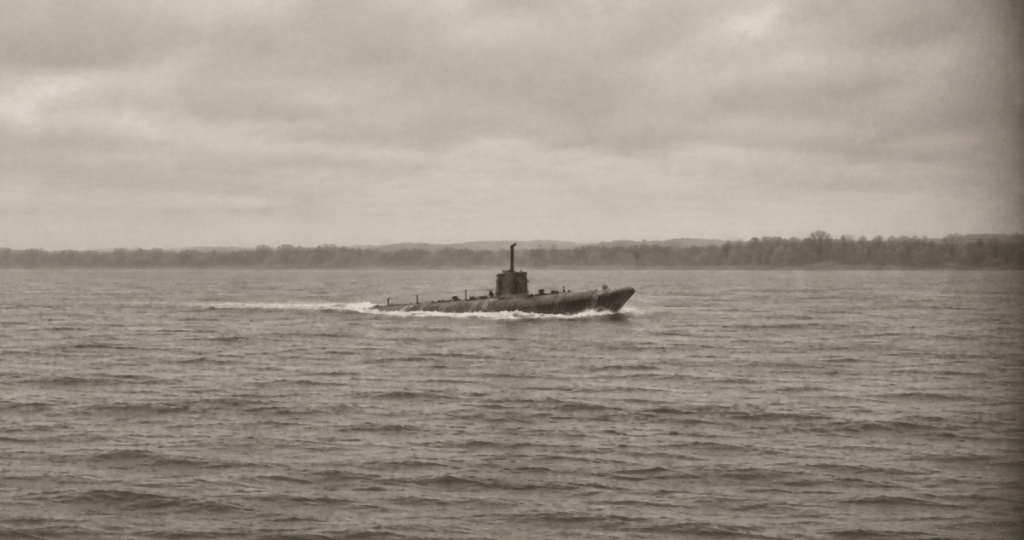
Joe Armstrong and the trial dives of Simon Lake’s submarines
Sixty feet down in the Housatonic River, a routine shakedown turned into a fight to get back to the surface. A seam parted in the forward compartment of one of Simon Lake’s submarines, and water came in with a loud hiss. Joe Armstrong called through the speaking tube to the bridge. “Take her up! Take her up quick!” As the bow came up, the water rose past the men’s ankles. They cheered when the boat broke the surface. The split seam was just clear of the waterline, and the boat limped back to the Lake Torpedo Boat Company yard at Bridgeport, Connecticut.
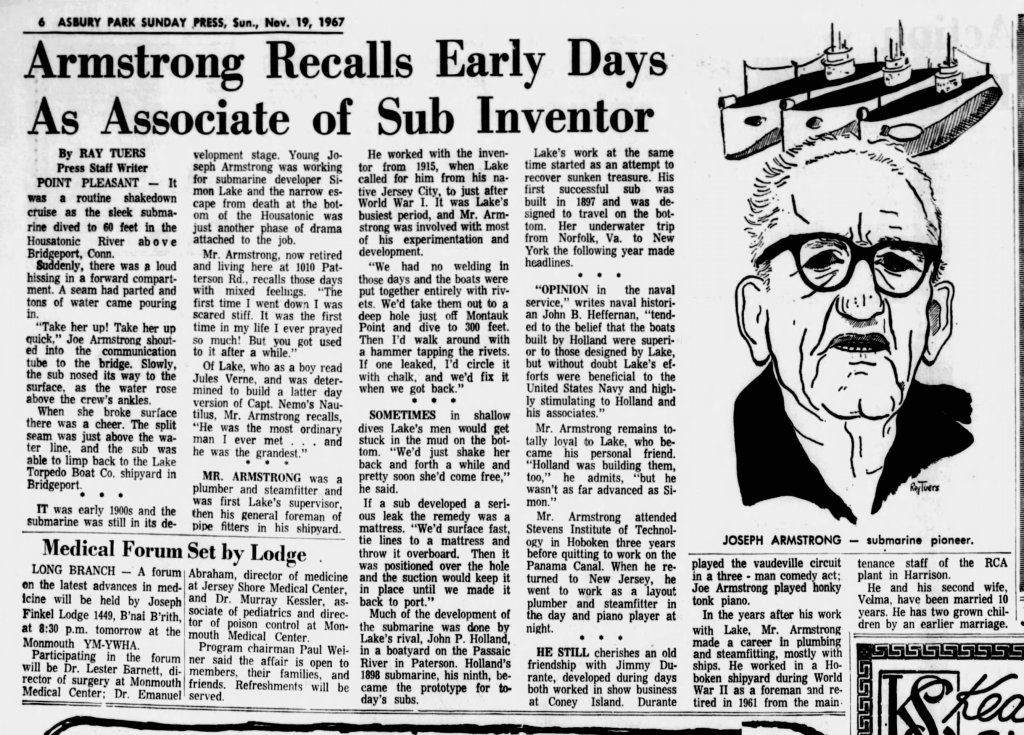
Armstrong remembered that run from retirement in Point Pleasant, New Jersey, in 1967. He also remembered how frightened he had been the first time he went down and how much he had prayed. In time, he said, he got used to diving. A man could get used to going below and still have good reason to pay close attention to what he heard in the forward compartment.
A native of Jersey City, Armstrong spent three years at Stevens Institute of Technology in Hoboken before leaving to work on the Panama Canal. When he returned to New Jersey, he laid out plumbing and worked as a steamfitter by day, then played piano at night. On Coney Island he became friends with Jimmy Durante, who was working the vaudeville circuit in a three-man comedy act. Armstrong played honky-tonk piano, and the friendship lasted long after both men left those jobs behind.
Lake called Armstrong to Bridgeport in 1915. The company was in a busy period of construction and experimentation that carried through the First World War. Armstrong started as a supervisor and rose to general foreman of pipefitters. He stayed until shortly after the war and went out on trials as well as working in the yard. Lake had been drawn to submarines by Jules Verne’s Captain Nemo. Armstrong came to know the man behind that ambition well enough to call him “the most ordinary man I ever met … and he was the grandest.”
The boats Armstrong took to sea were riveted. For deep trials, he recalled going out to a deep spot off Montauk Point, at the eastern end of Long Island, and diving to 300 feet. Once the boat was down, he walked through her tapping rivets with a hammer. When he found one leaking, he circled it in chalk. Once the boat was back alongside and the pressure was off the hull, the chalk showed the yard crew where to make the repair.
In shoal water the trouble could come from below. Once a boat settled into soft mud, she might stay there until the crew rocked her free. For a serious leak, Armstrong recalled a different expedient. They would surface, tie lines to a mattress and lower it over the side. The lines let them position it over the opening, where the incoming water drew it against the hull. If it held, the crew could get the boat back to port for a proper repair.
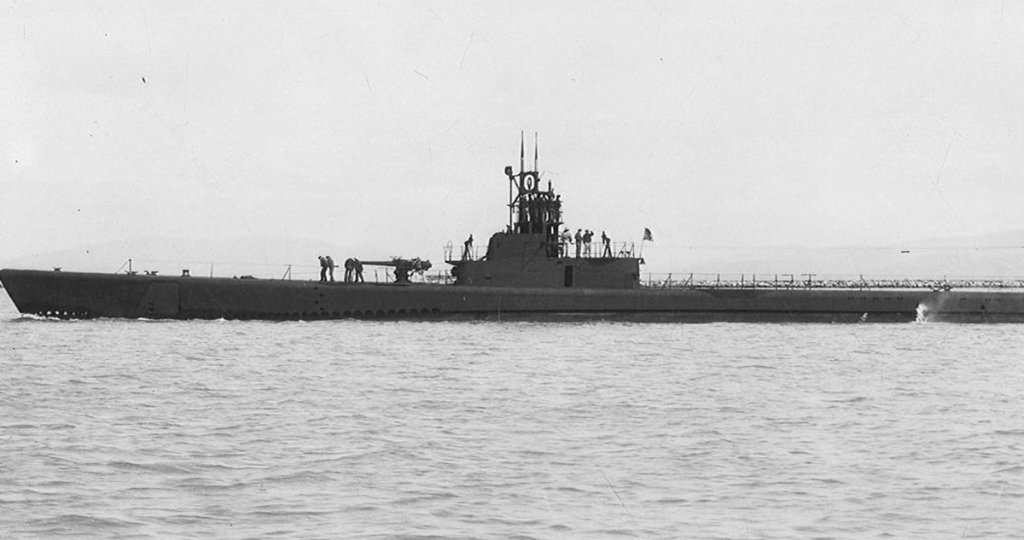
Lake’s interest in working on the bottom had taken shape well before Armstrong came to Bridgeport. His 1897 Argonaut had wheels to travel along the seabed and a compartment from which a diver could leave the boat underwater. A craft equipped that way could reach a wreck and put a man to work on it. John P. Holland’s experiments, which included work at Paterson, New Jersey, led to the boat the Navy purchased in April 1900 and commissioned that October as USS Holland. Lake’s designs also entered naval service. Seal, built at Newport News under subcontract from his company, was renamed G-1 and commissioned in 1912.
His associates. Armstrong had spent his time at sea in Lake’s boats and remained loyal to the man who built them. In his estimation, Holland had never caught up with Simon.
Armstrong spent much of the rest of his working life in marine plumbing and steamfitting. He was a foreman in a Hoboken shipyard during the Second World War and retired in 1961 from the maintenance staff at RCA’s Harrison plant. By the time he and his wife Velma were living in Point Pleasant and a reporter came to ask about Simon Lake, nuclear-powered boats were already making patrols. What Armstrong could give that reporter was a mechanic’s account of how an earlier generation got its boats to sea. The foreman who went down with a hammer and chalk came back with work for the yard. Then the boat could go down again.
Source Notes
Ray Tuers, “Armstrong Recalls Early Days As Associate of Sub Inventor,” Asbury Park Sunday Press, November 19, 1967, p. 6. The Housatonic boat and trial date are unidentified in the interview.
Naval History and Heritage Command, “Simon Lake,” “Submarine Force,” “G-1,” and Argonaut photographs NH 57030 and NH 57034.


Leave a Reply